

Agent-Facing Analytics

Millisecond OLAP at 30,000 queries per second.

High-concurrency, low-latency real-time analytics for agent-facing workloads. Fresh data, full-text search, SQL joins, and lakehouse context on one query path.

<10ms P99 latency Short-Circuit Plan, row cache, and prepared statements for every query shape.
30K QPS per node Point queries and OLAP on one serving path. Built for agent fan-out.
One unified engine Search, SQL joins, fresh data, and lakehouse access without sidecars.
Trusted for real-time analytics at
Meituan Baidu BYD JD.COM Tencent Music Kwai Xiaomi
The shift

Agents turned analytics into a high-concurrency, low-latency problem.

The infrastructure that worked for dashboards doesn't work when the consumer is an agent, not a human.

When agents become the primary data consumer, every assumption about analytics infrastructure changes. The query rate multiplies by 20-50x per business question. Freshness tolerance drops from minutes to seconds. Concurrency goes from single-digit analysts to thousands of simultaneous sessions.

Batch data warehouses designed for human dashboards cannot keep pace. They charge per-query at rates that make agent workloads 30x more expensive. They update hourly when agents need data from the last few seconds.

48%
of enterprises adopting agentic AI by end of 2025
20-50x
query multiplier per agent business question

"OpenAI's acquisition of Rockset signals that real-time analytical databases are becoming foundational infrastructure for AI applications."

— Industry analysis, 2024
Real-time operations monitoring at enterprise scale
Dashboards can wait. Agents cannot.

A slow report is a meeting. A slow agent is a failed user interaction.

An agent reply is a product interaction. It needs current state, relational context, search, and predictable latency in the same request path. The database serving it must deliver all four without stitching together separate systems.

Dashboard analytics

ConcurrencySingle-digit analysts refresh a page.
Latency toleranceSeconds to minutes. Humans wait.
FreshnessRefresh window measured in minutes.
QueriesAggregates, GROUP BY, and time-series.
Risk on slowAn analyst waits a minute.

Agent-facing analytics

Concurrency10K+ sessions, 30K QPS per node.
Latency toleranceSub-10ms P99. Agents iterate in milliseconds.
FreshnessOperational state, current as of right now.
QueriesSearch, joins, and point lookups together.
Risk on slowA user abandons the product.
Proof before architecture

The agent workload already runs on VeloDB. It just had a different name.

Customer-facing analytics has the same workload shape: fresh data, high fan-out, low-latency analytical serving on a request path.

BYD: from 3 minutes to 5 seconds

BYD modernized ad-hoc analytics on VeloDB to support high fan-out queries across real-time telemetry. Non-primary-key filters run faster, and JSON columns occupy less storage. The platform now handles over 100 TB of data.

5 secdata latency (from 3 min)
10xfaster non-PK filtering
<1/3JSON storage size
BYD automated manufacturing line powered by real-time analytics

JD.com: 10B+ rows daily

JD.com ingests more than ten billion rows daily across 30+ backend nodes for real-time order tracking and inventory analytics at peak concurrency.

Same workload shape

Customer-facing analytics already demands fresh data, high fan-out, and predictable latency. Agent workloads inherit the same pattern.

Production-proven scale

The same engine that handles JD.com's peak traffic and BYD's manufacturing telemetry serves agent workloads without architectural changes.

What VeloDB delivers

Low latency and high concurrency, plus everything else agents need.

Each one addresses a specific failure mode in agent workloads running on infrastructure designed for dashboards.

30K QPS

High concurrency at agent scale

Agents fire 20-50 queries per business question across thousands of sessions. VeloDB turns that fan-out from a scaling problem into a solved one.

<10ms

Low latency on every query shape

Point queries and complex analytics both stay under 10ms P99. Fast enough that agent interactions feel like product interactions, not database queries.

40x

Search and joins in one system

Full-text search with BM25 scoring runs directly inside SQL. Agents combine relevance search, relational joins, and analytics in a single query — no sidecar.

10M/s

Performance under rapidly changing data

Streaming ingest and CDC keep data fresh in seconds, not hours. Agents always operate on current state without sacrificing query performance.

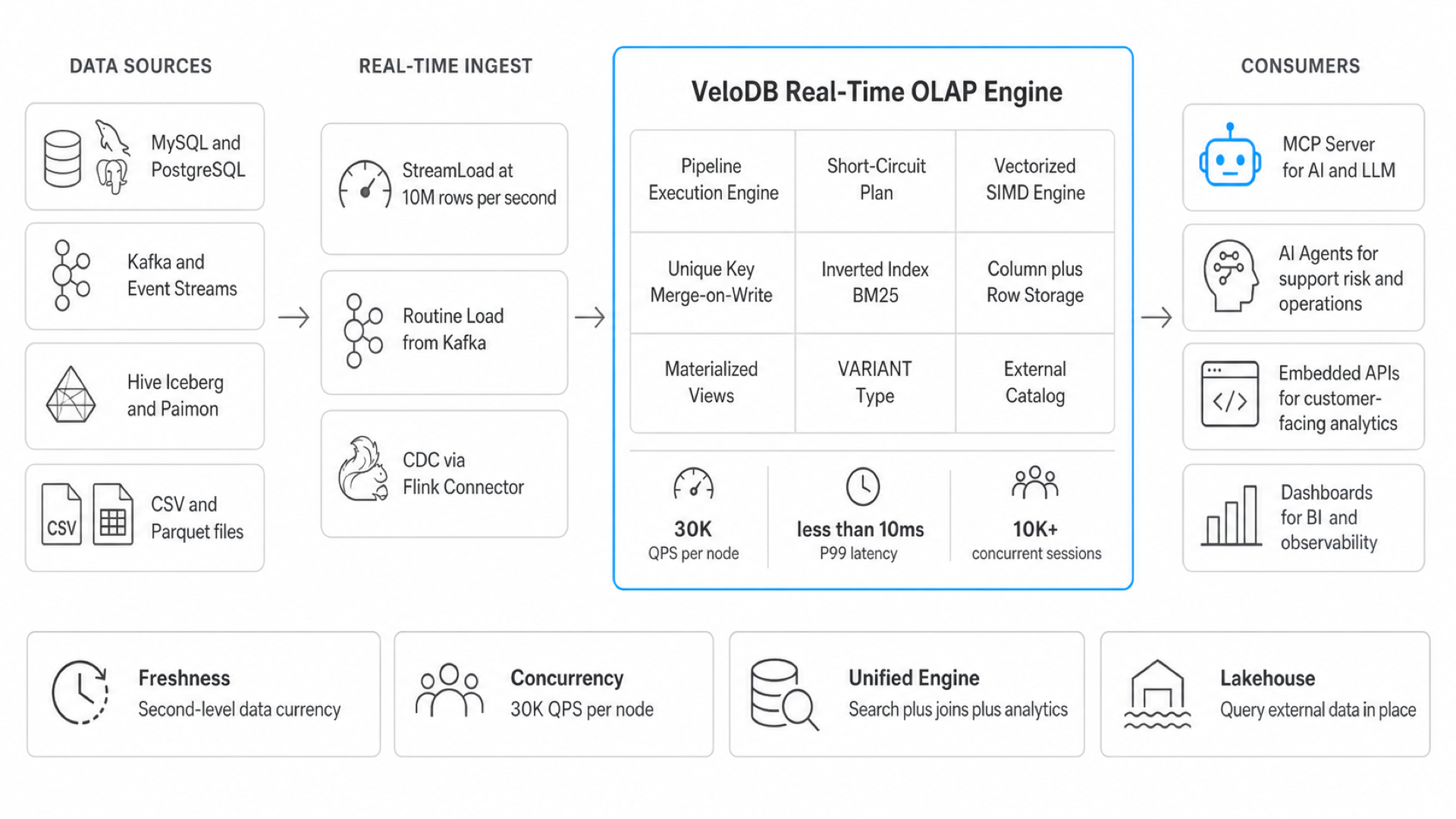
One OLAP serving layer

Sources, search, joins, and serving on one query path.

VeloDB keeps agent context current without adding a cache, search sidecar, or separate point-serving database.

VeloDB architecture diagram: Data Sources (MySQL, PostgreSQL, Kafka, Hive, Iceberg, Paimon) flow through Real-Time Ingest (StreamLoad, Routine Load, CDC) into VeloDB Real-Time OLAP Engine (Pipeline Execution, Short-Circuit Plan, Vectorized SIMD, Unique Key, Inverted Index BM25, Column plus Row Storage, Materialized Views, VARIANT, External Catalog) serving Consumers (MCP Server for AI, Agents, Embedded APIs, Dashboards). Key metrics: 30K QPS per node, less than 10ms P99, 10K+ concurrent sessions.
The work behind the millisecond answer

Ingest. Join. Search. Serve.

Every agent query runs through the same four-step path inside one engine, against one copy of the data, on one optimizer plan.

VeloDB query execution engine visualization

Ingest current events

StreamLoad pushes HTTP writes at 10M rows/s. Routine Load pulls continuously from Kafka. CDC captures changes from upstream databases in seconds.

StreamLoadRoutine LoadCDC

Join historical context

Merge-on-Write Unique Key model keeps mutable records current. Materialized views precompute repeated joins. VARIANT stores semi-structured JSON at 1/3 the storage cost.

Unique KeyMerge-on-WriteMaterialized Views

Search relevant records

Inverted Index with BM25 scoring runs full-text search inside SQL. No sidecar. Agents combine relevance search and relational analytics in one query.

BM25Inverted IndexCBO Joins

Serve under fan-out

Pipeline Execution Engine with SIMD vectorization. Short-Circuit Plan for point queries. Row cache and prepared statements keep P99 predictable at 30K QPS.

Pipeline EngineRow CachePrepared Statements
What VeloDB replaces

One serving layer instead of four.

Most agent stacks combine three or four databases to cover freshness, search, joins, and concurrency. VeloDB collapses that into one.

PostgreSQL / MySQL

Real-time updates, but row-based and single-node. Analytical queries take minutes at scale. Cannot serve thousands of concurrent agent sessions.

ClickHouse / Druid

Fast OLAP scans, but weak point lookups and update-in-place. You end up bolting on a serving cache and managing CDC pipelines separately.

Pinot / DynamoDB

High concurrency serving, but no SQL joins or relevance search. You add an Elasticsearch sidecar and a separate analytics layer.

VeloDB

Streaming ingest, UPSERT, full-text search, joins, point lookups, and lakehouse federation on one query path. One system replaces three — and charges for compute, not per-query.

Ready for an architecture review

Bring your freshness target. We will map the path.

Bring your fan-out profile, P99 budget, and the existing systems your agent reads from. We sketch the serving path and show what VeloDB collapses.